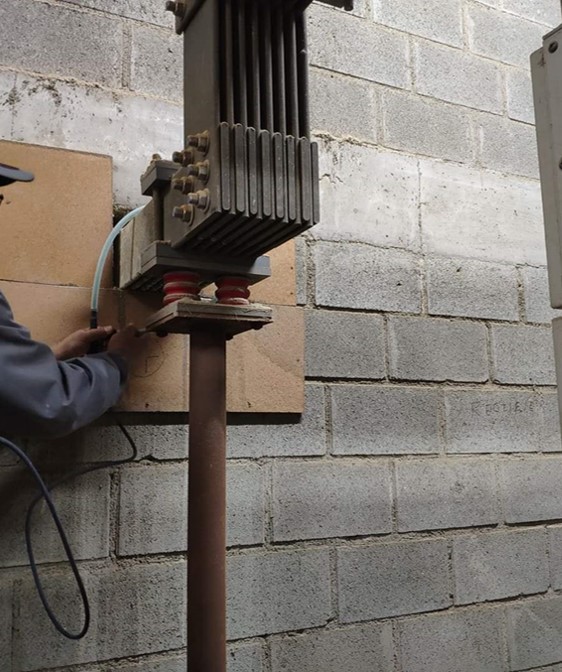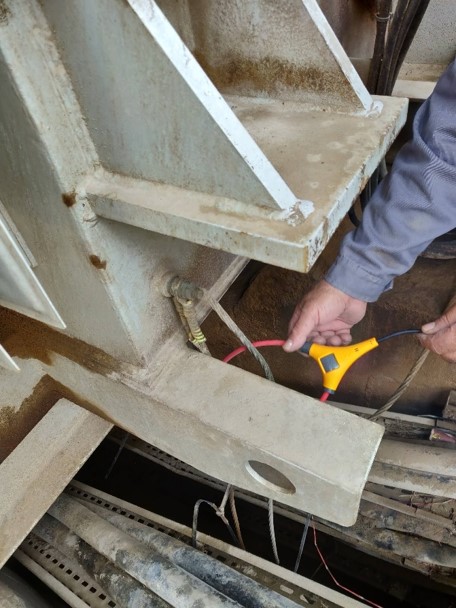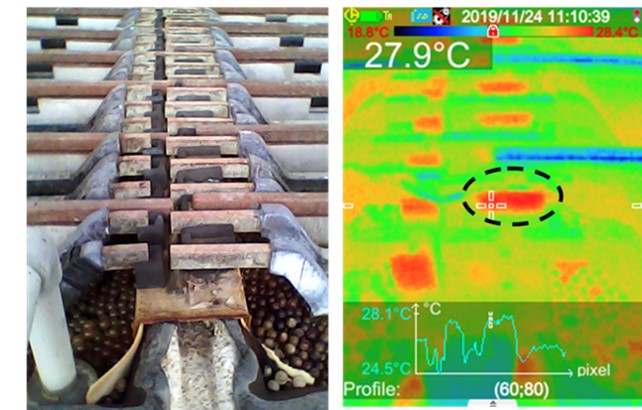
The Power Systems Modelling (PSM) Lab of the University of Cyprus and Hellenic Copper Mines (HCM) Ltd performed the first set of measurements at the Skouriotissa mine site. Electrowinning (EW) process is considered to be the most popular electrochemical process for the production of high purity metals such as copper, nickel, aluminium, lead, gold and silver. In brief, the process involves copper metal ions dissolved in an electrolyte which are reduced on the cathode surfaces producing metallic sheets. The reduction process takes place when a direct current (DC) is applied between anodes and cathodes. Industrial EW process normally takes 150 hours and produces copper sheets of 45 kg and 99.999 % purity. These days, industrial EW processes are carried out in large tank-houses with hundreds of cells arranged in circuits. These are driven by high-current rectifiers, rated up tens of kA, with yearly energy consumption rated on the millions of kWh. A typical large-scale EW plant can have efficiencies ranging from 82%-92%, however, a small drop of couple percent of efficiency would translate into millions of dollars’ worth of production. Considering the substantial energy requirements of these plants, it is important to maintain production efficiency as high as possible. As part of WP 5, the PSM Lab and HCM performed a set of measurements to identify the reasons for the decrease production efficiency. These tests included leakage current measurements on the bus-bars. Analysis of the transformer-rectifier losses and thermography using an IR camera.